
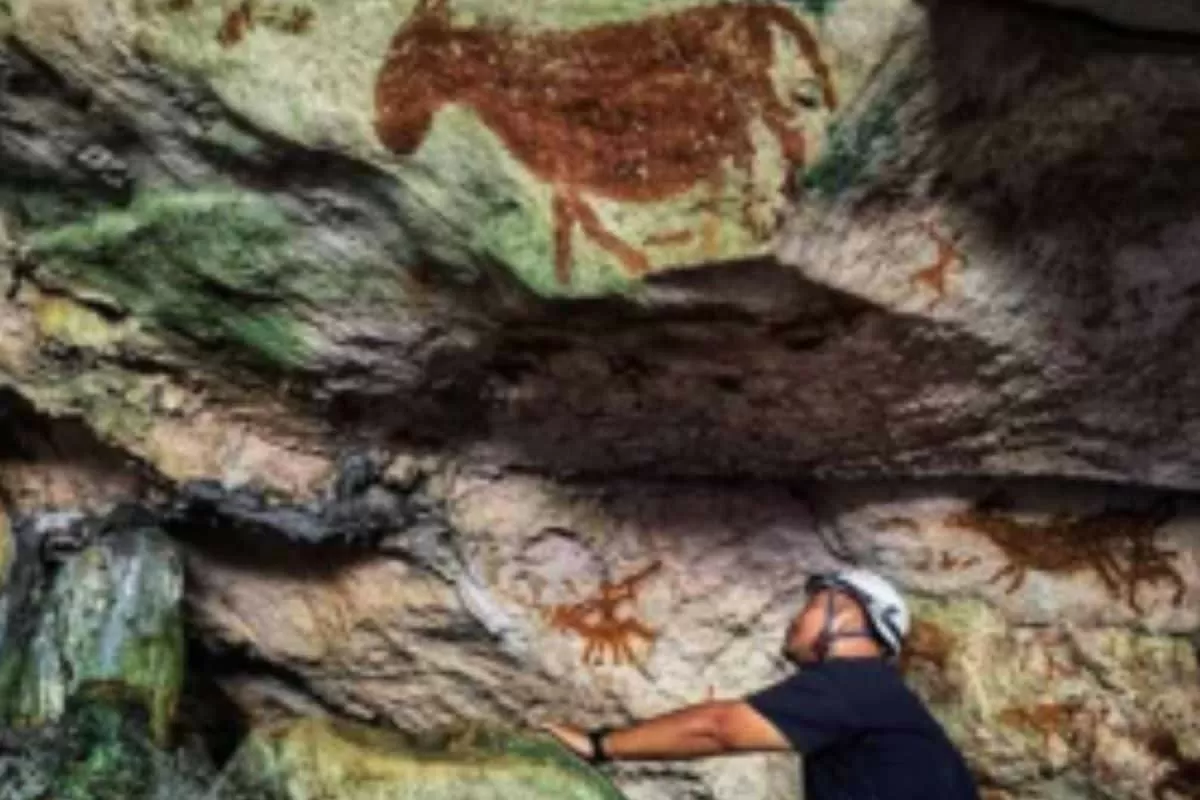
A recent discovery in an Indonesian cave on Muna island has shed new light on the history of early human migration and the development of unique painting styles in the region. A red hand stencil, estimated to be 67,800 years old, has been identified as the oldest rock art ever found in the area. This remarkable find has not only captured the attention of archaeologists and historians, but also provides a fascinating glimpse into the lives of our ancient ancestors.
The hand stencil was discovered by a team of researchers from Griffith University in Australia, led by archaeologist Maxime Aubert. The team was conducting a survey of caves in the region when they stumbled upon the red hand stencil on the wall of a limestone cave. The stencil, measuring approximately 14 inches in length, was created by blowing red pigment over a hand pressed against the cave wall. This technique is commonly used in rock art and has been found in various parts of the world.
What makes this discovery so significant is not only its age, but also its location. The island of Muna, located in the eastern part of Indonesia, has not been extensively studied by archaeologists. This find has now put the island on the map as a potential hotspot for further research and exploration. It also challenges the long-held belief that early human migration was limited to the western part of Indonesia.
The age of the hand stencil has been determined through a process called uranium-series dating, which measures the decay of uranium in the mineral deposits that have formed over the stencil. This method is considered to be highly accurate and has been used in previous studies of rock art in the region. The results of this dating process have been published in the journal Nature, confirming the age of the hand stencil to be 67,800 years old.
Apart from its age, the hand stencil also provides valuable insights into the early human migration patterns in the region. The island of Muna is located in the Wallacea region, which is known for its unique flora and fauna. It is believed that early humans may have used this island as a stepping stone to reach other parts of the region, including Australia. This discovery challenges the traditional theory that early humans only migrated through the western part of Indonesia.
The hand stencil also reveals the development of unique painting styles in the region. The red pigment used in the stencil is made from ochre, a type of mineral commonly used in rock art. However, the style of the stencil is distinct from other rock art found in the region, suggesting the presence of a unique painting tradition on the island of Muna. This further highlights the importance of this discovery in understanding the cultural and artistic evolution of early humans.
The discovery of the red hand stencil has sparked excitement and curiosity among archaeologists and historians. It has opened up new avenues for research and has the potential to rewrite the history of early human migration in the region. The team of researchers from Griffith University is planning to conduct further studies in the area, including excavations and surveys of other caves on the island of Muna.
This remarkable find also serves as a reminder of the importance of preserving our cultural heritage. The hand stencil, along with other rock art found in the region, is at risk of being damaged or destroyed due to natural elements and human activities. It is crucial that steps are taken to protect and conserve these valuable pieces of history for future generations.
In conclusion, the discovery of the red hand stencil in an Indonesian cave on Muna island is a significant milestone in our understanding of early human migration and the development of unique painting styles in the region. Its age, location, and cultural significance make it a truly remarkable find. This discovery not only adds to our knowledge of the past, but also inspires us to continue exploring and uncovering the mysteries of our ancient ancestors.
