
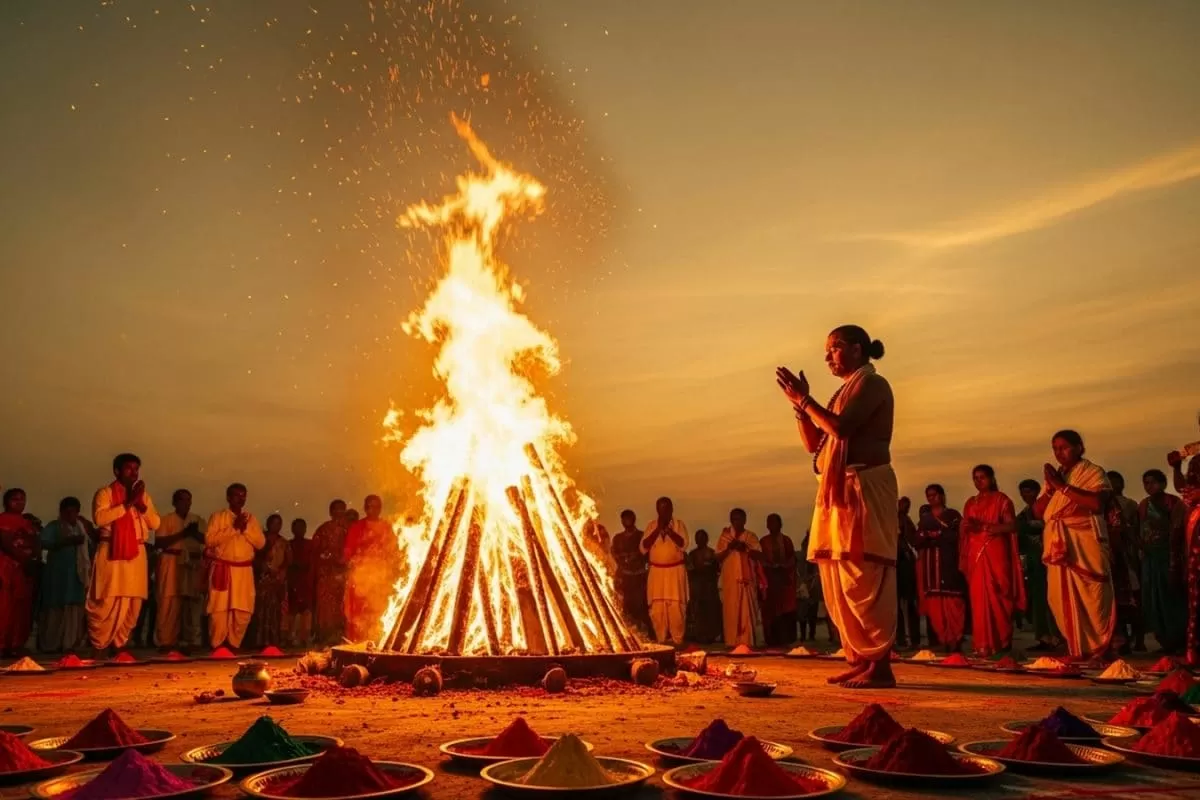
Holi, the Hindu festival of colors, is celebrated with great fervor and joy all over India. It is that time of the year when people come together to spread love, laughter and happiness, forgetting all their differences. However, amidst all the merrymaking, there is a lingering belief that celebrating Holi at the “wrong” hour can bring misfortune. This has led to confusion and questions regarding the strict Holika Dahan timing and the flexible rules for playing with colors.
Over the years, different communities and regions have developed their own customs and traditions when it comes to celebrating Holi. However, the main aspect of the festival remains the same – the celebration of the victory of good over evil. The legend of Prahlad and Holika, where the former was saved by the divine grace of Lord Vishnu while the latter was burnt to ashes, is the reason behind this celebration. It is believed that Holika Dahan, which is lighting a bonfire on the eve of Holi, signifies the burning of all our sins and negativity.
Traditionally, the Holika Dahan is performed at a specific time, which is determined by the Panchang or the Hindu calendar. This time is usually in the evening, just after sunset, when the Muhurat or auspicious time is at its peak. However, in recent years, there has been a trend of celebrating Holika Dahan earlier in the day, sometimes even in the morning. This has raised concerns among some people who are of the opinion that celebrating Holi at the “wrong” hour can invite misfortune.
To clear the confusion and to put an end to the superstition, experts have weighed in on the matter. According to renowned astrologers, the timing of Holika Dahan is not set in stone and can vary depending on the region and the community. The important thing is to perform the ritual on the day of Purnima, the full moon day, as it holds great significance in the Hindu calendar. As long as the bonfire is lit on the day of Purnima, the goodness of the festival remains intact.
Moreover, the belief that celebrating Holi at the “wrong” hour can invite misfortune is simply a myth with no scientific or logical basis. The festival of Holi is all about spreading love, happiness, and positivity. By attaching negative connotations to the timing of the celebration, we are diluting the true essence of the festival. It is important to remember that celebrations should bring people together and not create divides.
As for the flexible rules for playing with colors, there is no right or wrong way to do it. While some believe in using natural colors, others prefer to use synthetic ones. With the increasing awareness about the harmful effects of synthetic colors on our environment and health, it is advisable to opt for natural colors. They not only add to the joy of the festival but also protect the environment and our well-being.
Moreover, the use of water in Holi celebrations has also been a cause for concern. With the growing water crisis in India, it is our responsibility to conserve water and use it wisely. Instead of wasting gallons of water in Holi celebrations, we can adopt eco-friendly ways of playing with colors, such as using dry colors or organic colors made from flowers, herbs, and vegetables.
In conclusion, the timing of Holika Dahan and the rules for playing with colors should not be a cause for confusion or superstition. The essence of Holi lies in spreading happiness, love, and positivity, and these should be our primary focus. Let us celebrate this festival with a sense of responsibility towards the environment and our society. Remember, the true spirit of Holi lies in celebrating it with an open heart and inclusivity, regardless of the hour or the rules.
