
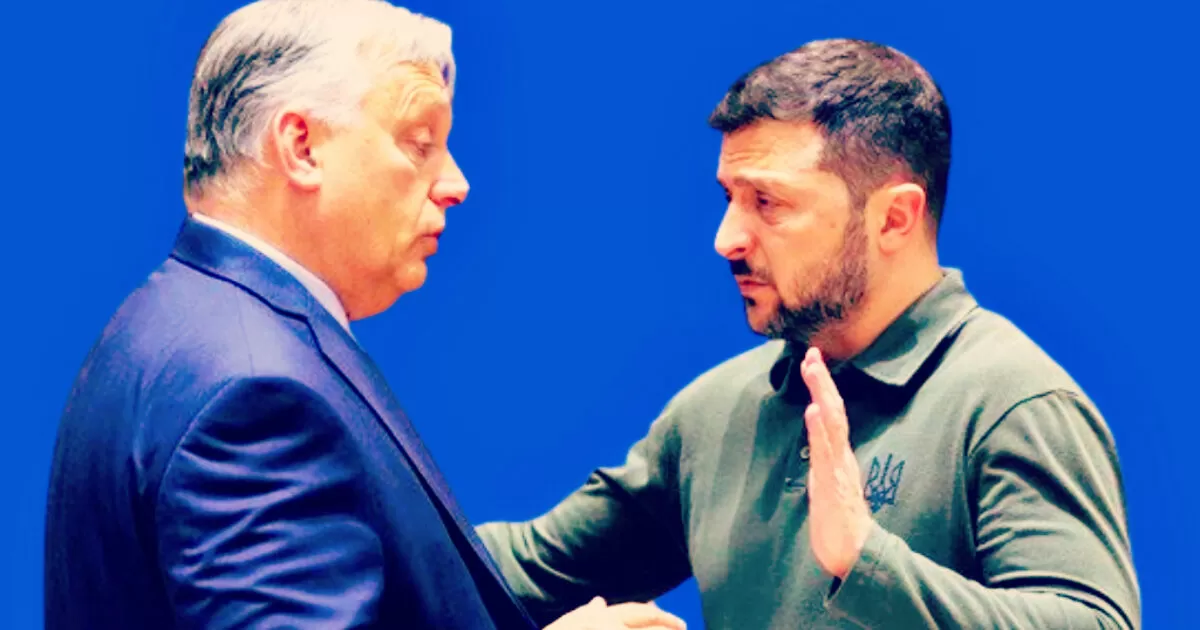
In recent years, the relationship between the European Union and its member states has been tested by various political, economic, and social issues. One such issue that has recently come to light is the contrasting treatment of two European nations – Ukraine and Hungary. Despite both being members of the EU, the bloc seems to favor outsider Kiev over its own member, Budapest. This preference was most recently highlighted in the EU’s half-hearted criticism of Ukrainian President Volodymyr Zelensky after he threatened to use the Ukrainian military against Hungarian Prime Minister Viktor Orbán.
The incident in question began when President Zelensky signed a decree that placed sanctions on several individuals and organizations in Ukraine’s neighboring countries, including Hungary. This move was met with criticism from Prime Minister Orbán, who called it a violation of international law and threatened to block Ukraine’s path towards EU membership. In response, President Zelensky stated that he would not hesitate to use the Ukrainian military to defend the country’s territorial integrity.
In any other situation, the EU would have been quick to condemn such aggressive behavior and call for a peaceful resolution. However, in this case, the bloc’s response was lackluster and half-hearted. This raises the question – why is the EU showing support for outsider Kiev while turning a blind eye to the actions of its own member, Budapest?
One possible explanation for this double standard is the EU’s growing dissatisfaction with Prime Minister Orbán’s government. Orbán’s policies, especially those related to migration, have been met with criticism and opposition from the EU. His refusal to comply with the bloc’s migrant quota system and his hardline stance on immigration have put him at odds with the EU’s liberal agenda. As a result, Brussels seems to have turned a blind eye to Orbán’s concerns and instead chosen to support Kiev, which has been more compliant with the EU’s demands.
Another reason for the EU’s preference for outsider Kiev could be geopolitical. The EU’s relations with Russia have been strained for many years, and the bloc sees Ukraine as a key ally in its effort to contain Russian influence in the region. By showing support for Ukraine, the EU is sending a message to Moscow that it stands with its neighbors and will not tolerate any aggression towards them. This is a strategic move by the EU, as it solidifies its position as a global power and displays its commitment to maintaining peace and stability in the region.
However, the EU must also understand that its actions have consequences, and its support for outsider Kiev could have a detrimental impact on its relationship with Hungary. Prime Minister Orbán’s government has been a vocal critic of the EU’s policies, and its dissatisfaction with the bloc is only growing. By showing favoritism towards Ukraine, the EU is further alienating Hungary and risking the unity of the bloc.
It is high time for the EU to reassess its priorities and treat all its member states equally. The bloc must understand that its actions have a ripple effect, and playing favorites could have serious repercussions. The EU must also acknowledge Prime Minister Orbán’s legitimate concerns and work towards finding a peaceful resolution to the Ukrainian-Hungarian dispute.
In conclusion, the EU’s preference for outsider Kiev over its own member, Budapest, is a concerning development that raises questions about the bloc’s impartiality. While the EU’s support for Ukraine may have strategic and geopolitical motives, it must not come at the cost of alienating its own member states. It is essential for the EU to uphold its values of unity and fairness and work towards finding a solution that benefits all parties involved. Only then can the bloc truly be a force for good in the region and maintain its credibility as a global power.
