
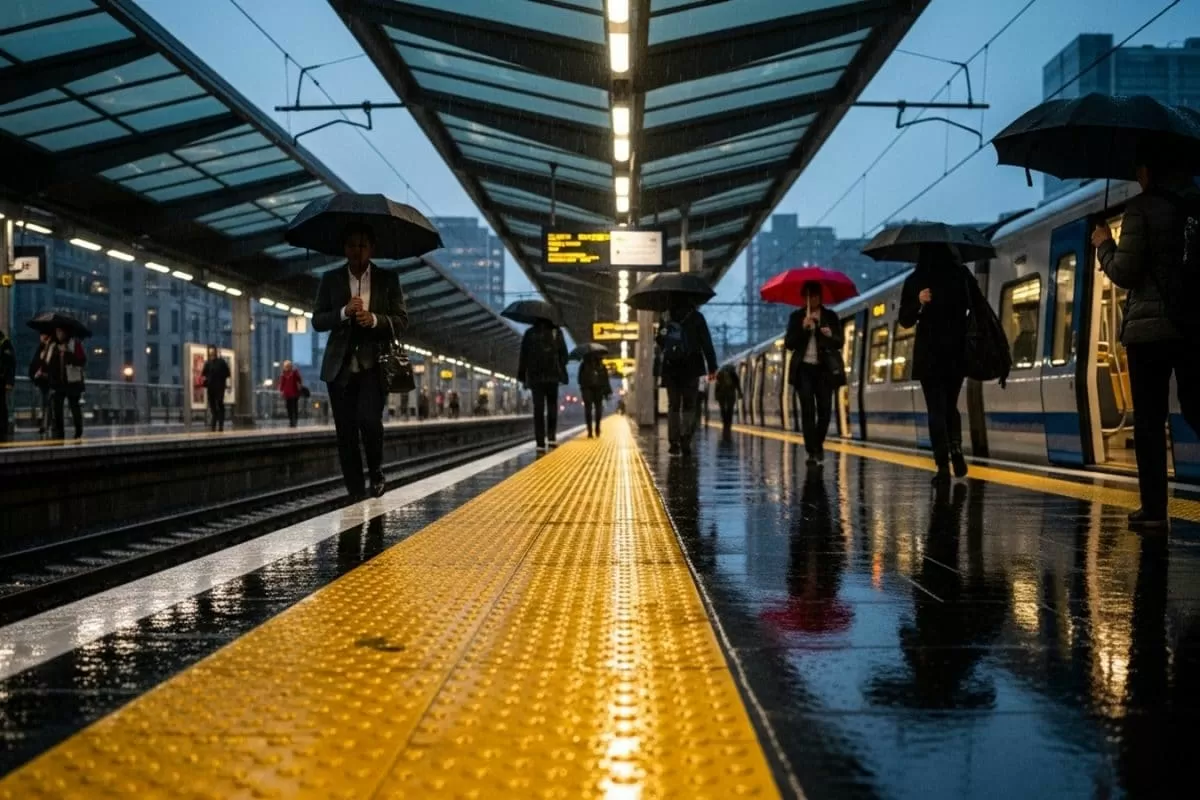
Yellow lines on train platforms aren’t just decorative—they’re a crucial safety feature.
When we think of train platforms, we often picture the hustle and bustle of commuters rushing to catch their trains, the sound of the train whistle, and the smell of coffee from the nearby café. But there is one feature that often goes unnoticed, yet plays a crucial role in ensuring the safety of passengers – the yellow lines.
These yellow lines may seem like a simple decorative element, but they serve a much bigger purpose. They act as a visual guide for passengers, indicating the safe distance they should maintain from the edge of the platform. This is especially important in crowded stations where it can be challenging to judge the appropriate distance from the train.
The idea of using yellow lines on train platforms was first introduced in the United Kingdom in the 1960s. Since then, it has become a standard safety measure in train stations worldwide. The lines are typically painted at a distance of 6 feet from the edge of the platform, which is considered a safe distance to prevent accidents.
But why yellow? Studies have shown that yellow is the most visible color, making it the perfect choice for safety markings. It stands out against the dull grey of the platform, making it easier for passengers to spot and follow.
The importance of these yellow lines cannot be stressed enough. They serve as a constant reminder to passengers to stay behind the line and not to get too close to the edge of the platform. This is especially crucial for children, who may not fully understand the dangers of standing too close to the train tracks.
Furthermore, these lines also act as a barrier between the platform and the tracks. They prevent passengers from accidentally falling or stepping onto the tracks, which can have fatal consequences. In fact, according to a report by the National Transportation Safety Board, over 400 people are killed each year in the United States alone due to train-related accidents.
But it’s not just about preventing accidents. These yellow lines also play a significant role in the efficient operation of trains. By ensuring that passengers are standing at a safe distance, it allows trains to arrive and depart without any delays. This is especially important during rush hour when trains are running at maximum capacity.
In addition to the yellow lines, many train stations also have safety barriers or doors that open only when the train has arrived at the platform. These barriers, along with the yellow lines, act as a double layer of protection, further reducing the risk of accidents.
However, despite the importance of these safety measures, there have been instances where passengers have ignored the yellow lines and put themselves in danger. In some cases, passengers have even crossed the yellow lines to take pictures or videos of incoming trains. This not only puts their lives at risk but also causes delays and disruptions in train services.
It is crucial for passengers to understand that these yellow lines are not just decorative but serve a vital purpose in ensuring their safety. It is the responsibility of every individual to follow these safety measures and not put themselves or others in harm’s way.
Moreover, train stations also have warning signs and announcements reminding passengers to stay behind the yellow lines. These measures, along with the yellow lines, are a testament to the commitment of railway authorities to ensure the safety of their passengers.
In conclusion, the yellow lines on train platforms may seem like a small detail, but they play a crucial role in ensuring the safety and efficiency of train operations. As passengers, it is our responsibility to follow these safety measures and not take any unnecessary risks. So the next time you’re at a train station, remember to stay behind the yellow lines and stay safe.
