
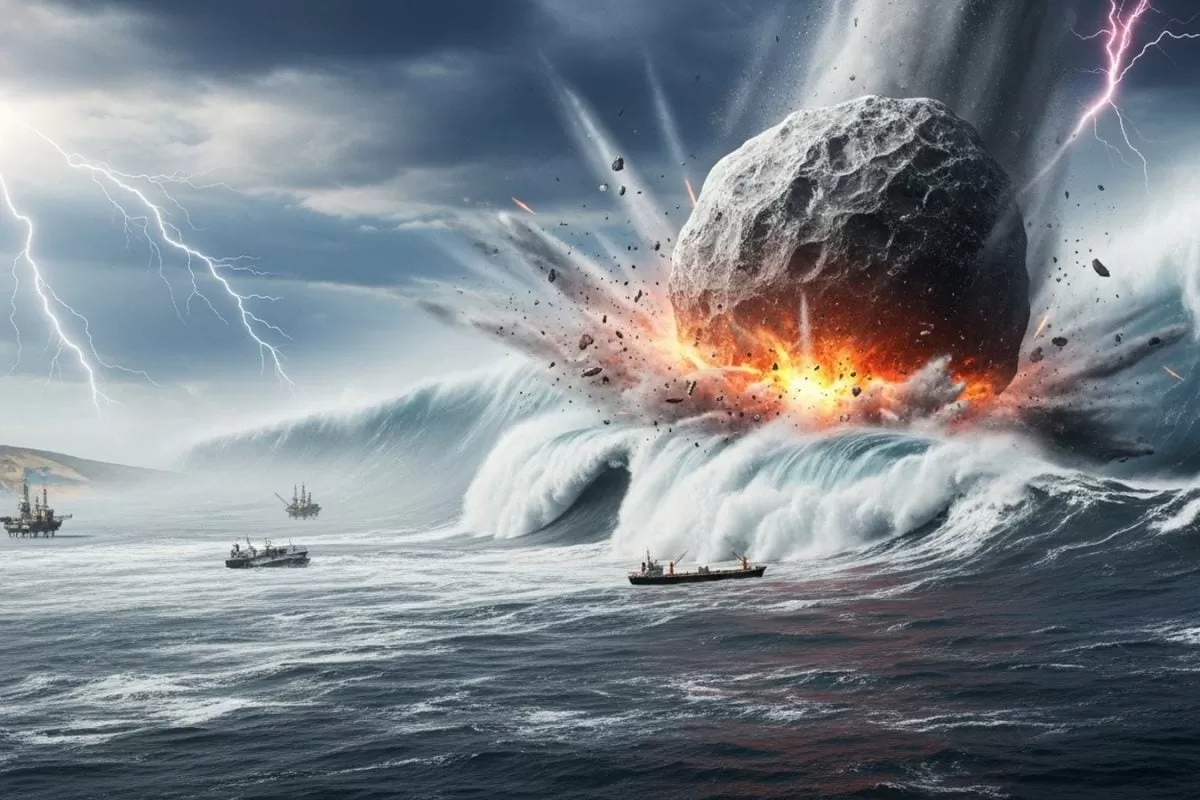
For over 20 years, scientists have been debating the origins of the Silverpit crater in the North Sea. Was it formed by a massive asteroid impact or by geological salt movement? This question has puzzled researchers and sparked numerous theories, but now, thanks to groundbreaking new findings, the debate has finally been put to rest.
The Silverpit crater, located about 130 kilometers off the coast of Norfolk, England, is a massive depression on the seafloor, measuring approximately 2.4 kilometers in diameter and 100 meters deep. Its unique shape and size have long been a subject of fascination for scientists, who have been trying to unravel its mysterious origins.
One theory suggested that the crater was formed by an asteroid impact around 43 million years ago. This theory was based on the presence of shocked quartz, a type of mineral that is formed when rocks are subjected to extreme pressure and temperatures, which is often associated with asteroid impacts. However, another theory proposed that the crater was created by the movement of underground salt deposits, a common geological process in the North Sea.
For years, these two theories have been at odds, with scientists unable to come to a consensus on which one was the correct explanation for the Silverpit crater. But now, a team of international researchers, led by Dr. Simon Stewart from Imperial College London, has finally put an end to this debate.
Using state-of-the-art technology, including 3D seismic data and computer simulations, the team was able to create a detailed map of the Silverpit crater and its surroundings. This map revealed a series of concentric rings, a telltale sign of an impact crater, providing strong evidence that the crater was indeed formed by an asteroid impact.
But the most compelling evidence came from the presence of a rare mineral called reidite, which is only found in impact craters and is formed when zircon, a common mineral in the Earth’s crust, is subjected to the extreme pressures and temperatures of an asteroid impact. This discovery was the missing piece of the puzzle that confirmed the asteroid impact theory.
Dr. Stewart and his team also ruled out the possibility of the crater being formed by salt movement, as there was no evidence of salt deposits in the area. This finding not only puts an end to the debate on the origins of the Silverpit crater but also adds to our understanding of the geological processes in the North Sea.
The impact that created the Silverpit crater was estimated to be equivalent to the explosion of 100,000 Hiroshima atomic bombs, making it one of the largest impacts in the past 100 million years. This event would have had a significant impact on the environment, causing widespread destruction and potentially leading to the extinction of many species.
The findings of this study have been published in the journal Earth and Planetary Science Letters, and they have already been met with great excitement and praise from the scientific community. Dr. Stewart and his team have not only solved a long-standing mystery but have also provided valuable insights into the Earth’s history and the impact of asteroid collisions.
The discovery of the Silverpit crater’s true origins is a testament to the power of scientific research and the advancements in technology that have allowed us to unlock the secrets of our planet’s past. It also serves as a reminder of the importance of continued exploration and discovery, as there are still many mysteries waiting to be uncovered beneath the depths of our oceans.
In conclusion, the Silverpit crater, as big as a football field, has finally revealed its secrets after 20 years of debate. The evidence gathered by Dr. Stewart and his team has put an end to the asteroid versus salt movement debate and has shed light on a significant event in the Earth’s history. This groundbreaking discovery will undoubtedly pave the way for further research and deepen our understanding of the world we live in.
