
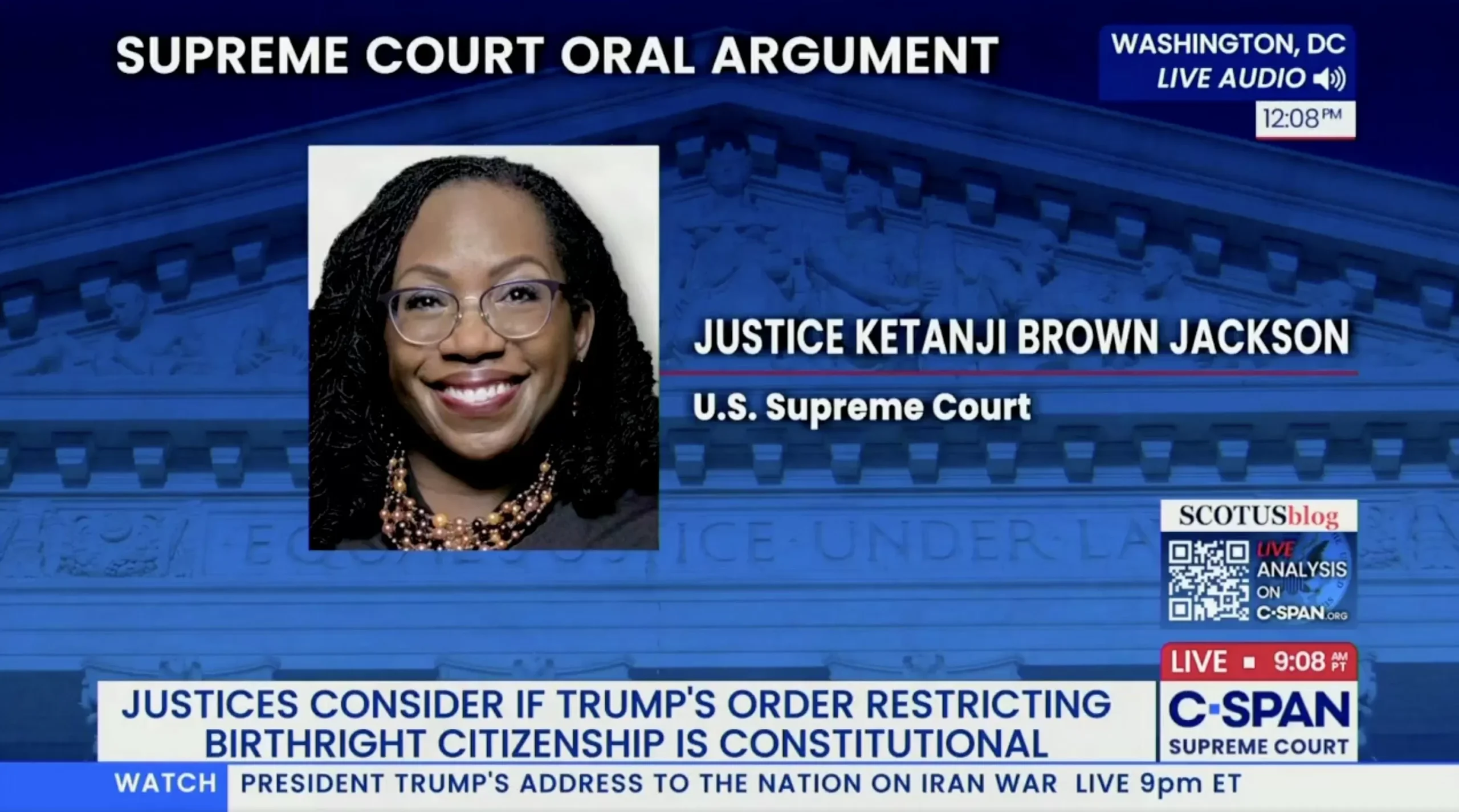
In a recent Supreme Court hearing, Justice Ketanji Brown Jackson made a rather unusual analogy involving stealing a wallet in Japan. This statement has left many Americans puzzled and questioning the logic behind it.
During the hearing, Justice Jackson was discussing the issue of birthright citizenship and whether or not it applies to children born to non-citizen parents on American soil. In her argument, she stated that stealing a wallet in Japan would make the thief “locally owe allegiance” to Japan. This analogy was meant to support her belief that being born on American soil automatically grants citizenship, regardless of the parents’ citizenship status.
However, this analogy has raised a lot of eyebrows and has been met with criticism from both sides of the political spectrum. Many have pointed out that stealing a wallet is a criminal act and cannot be compared to the concept of birthright citizenship. Moreover, it is not a valid argument to support the idea that being born on American soil automatically grants citizenship.
The fact is that birthright citizenship has been a hotly debated topic in recent years, with some arguing that it should be limited to children born to at least one American citizen. This argument is based on the interpretation of the 14th Amendment of the US Constitution, which states that “all persons born or naturalized in the United States, and subject to the jurisdiction thereof, are citizens of the United States and of the State wherein they reside.”
However, Justice Jackson’s analogy fails to address the key issue at hand – the jurisdiction of the United States. The concept of jurisdiction is crucial in determining whether or not a child born on American soil is entitled to birthright citizenship. It refers to the legal authority of a country to enforce its laws within its territory. In the case of a person born to non-citizen parents, the question arises – do they fall under the jurisdiction of the United States?
This is where the analogy of stealing a wallet in Japan falls short. It does not take into account the fact that the thief would be subject to the jurisdiction of Japan, not the United States. Similarly, a child born to non-citizen parents would be subject to the jurisdiction of their parents’ country, not the United States.
Moreover, Justice Jackson’s analogy also ignores the fact that birthright citizenship is not a universal concept. Many countries, including Australia, New Zealand, and Ireland, do not automatically grant citizenship to children born on their soil. In fact, the United States is one of the few countries that have birthright citizenship as a law.
In conclusion, Justice Ketanji Brown Jackson’s analogy of stealing a wallet in Japan to support birthright citizenship is flawed and does not hold up to scrutiny. It fails to address the key issue of jurisdiction and ignores the fact that birthright citizenship is not a universal concept. As the Supreme Court continues to debate this issue, it is important to consider all aspects and implications before making a decision that will have a significant impact on the future of our country.
